Worn into the ground by centuries of hooves, the transhumant routes of Corsica's interior are a different kind of map — one that the land itself has kept.
What the ground remembers
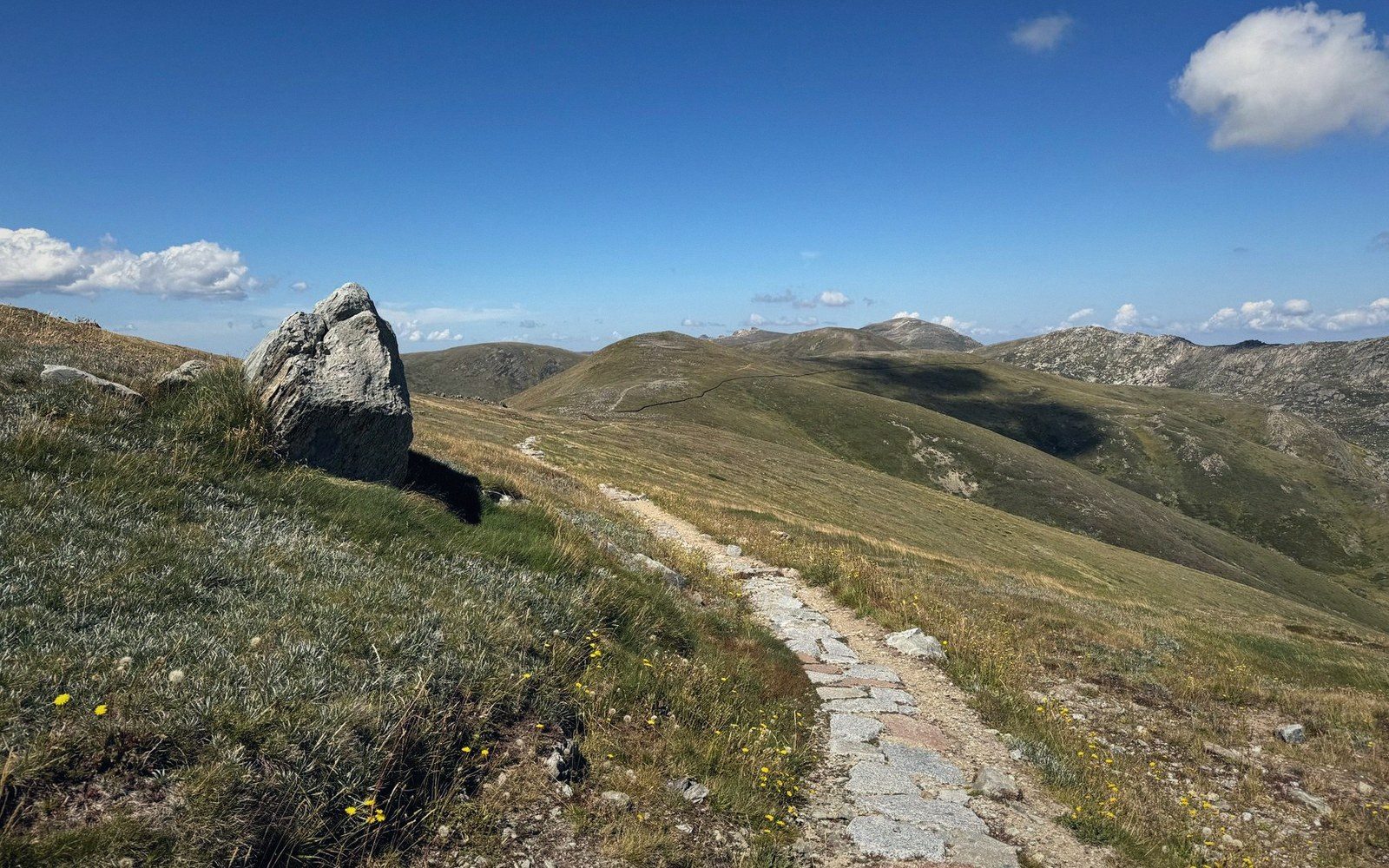
A drove road does not look like a road. It has no surfacing, no kerb, no engineered camber. What it has is a hollow: a shallow trough worn into the hillside by the repeated passage of the same feet, year after year, over a period that can span many centuries. In Corsica's granite interior, where the rock lies close to the surface, these hollows can be cut surprisingly deep — half a metre is not unusual where the path crosses softer ground between outcrops. On bare rock, the route shows differently: a faint polish, or a line of small cairns placed by shepherds to mark the way through cloud.
The routes linked winter pasture near the coast with summer grazing on the high presa — the mountain plateau — following the logic of altitude and water rather than any administrative boundary. They tended to stay on ridgelines where the ground was dry and the animals could move without bogging, dropping into valley bottoms only where a stream crossing was unavoidable. At those crossings, flat stones were often laid, not as a formal ford but as a convenience: a shepherd carrying a kid, or managing a lame ewe, needed a dry foot. The stones are still there at some crossings, half-buried, carrying no traffic.
Spacing along the route was governed by water and shelter. The drystone huts that punctuate the high zones are rarely random in their placement; they sit at intervals roughly matching a day's movement for a flock, close to a spring, with a fold nearby. The path connects them the way a sentence connects its words — each stop makes sense of the next.
What makes these routes legible as infrastructure rather than accident is their consistency. They do not wander the way a single animal's track wanders. They hold a line, and they have held it long enough for the hollow to form, for the vegetation on either side to differ from the vegetation in the worn centre, for the shepherds of the eighteenth century to be following the same ground as their predecessors of the thirteenth. The land was the archive. It still is.