There is a great deal written about politics and the administration of Corsica - most of it in French. Here are the basics and if you want more, then a good way to start is to ask good old Google your questions, so just type them in below and off you go!
Corsican public and political life is often not well appreciated outside the island - myths and legends abound, let alone misconceptions and misreporting. Much of this comes from historical editorialising as well as present day enthusiasm for negative news. It is interesting to remember that while all kinds of outsiders have been involved in Corsica's story, over the millennia, Corsicans have not set out to involve themselves in the affairs of others.
As anywhere else in the world, Corsican public life is complex, rich and evolving. At the present time, some would say that things are moving quickly towards greater autonomy, while others are convinced that the centralist French constitution will ensure that nothing fundamentally changes in the way that Corsica is governed so long as it remains part of France.
You may ask whether Corsica is like France. Superficially the answer is yes. Fundamentally, the answer is no. For a start it is an island, not a continental landmass. Its boundaries have been fixed for thousands of years more than those of France. It has different history and culture and has been traditionally an agro-pastoral community, largely untouched by the industrial revolution. Corsica has only been French for 200 years or so of its 4000-year history. Before that, it was Genoese for 500 years or so, with many interruptions and they were preceded by the Pisans. The dominant nature of Corsica is from the interior of the island. Life has consistently been hard. It had the riches that have flowed from the defiance of intruders. Survival came from sharing and creative solutions to the problems of daily life. Traditions have endured.
If you want a simple picture of ethnographic change in Corsica from 1770-2003, then take a look at a mine of data with lots of graphics, called L'Atlas Ethnohistorique de la Corse. It's work conducted by the Comité des Travaux Historiques et Scientifiques (founded in 1834) and directed by the veteran ethnographer, Georges Ravis-Giordani.
If you want the basic facts and demographics of Corsica in 2004, then you can download a 10pp booklet in pdf (produced by INSEE, the national statistics office), by clicking here; it's a handy guide, though of course some of the data are not completely up to the minute.
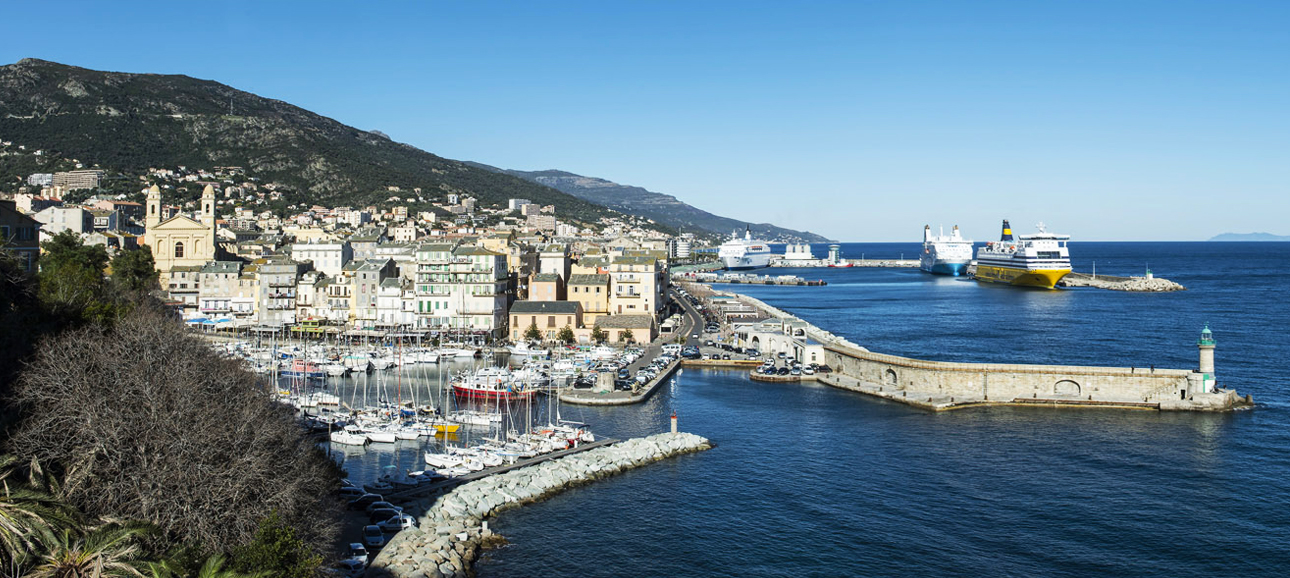
People ask if Corsica is a country. It is, yes, if you agree that a country is the 'land of a region', or the 'territory of a nation' (when a nation means a 'large number of people of mainly common descent, language, history etc'). No, if you think of a country as being run by an independent government, or being an internationally recognised political entity - in which case it is part of France. Administratively, it forms two Départements of France. Haute Corse (2B) is to the north and its capital is Bastia. To the south is Corse du Sud (2A) with its capital in Ajaccio, which is also the regional capital and is the seat of the regional government - the Collectivité Territoriale de Corse (CTC). Most Corsicans would probably say "primu corsu, franchese dopu" - I am first Corsican, then French. A recent survey found that only 8% felt more French than Corsican, though 14% did think of themselves as French.
In
school history lessons, a frequent essay subject concerned whether or
not national character existed. Like so many questions about the
island, the answer concerning Corsica is both yes and no. Corsican
history has been turbulent and the country has had many different
racial influences. Three tendencies might be seen as significant:
Insularity; Mediterranean-ness; Frenchness. The first you could
describe as being reserved and proud; the second as having a
spontaneous and spiritual nature; the third as being full of
ambivalence. 
Population The population of Corsica is about 275 000 - up by some 15 000 since 1999 - a faster rate than the rest of France. About 170 000 are of Corsican origin. Ten per cent of the population are foreigners (to France), of whom the biggest groups are Moroccans (14000) and Portuguese (4000). The biggest concentrations are in greater Ajaccio (77 300), greater Bastia (76 400) and Porto Vecchio (10 300). Thus nearly 60% of Corsica's population lives in these two cities. Very small proportions live in the interior - in 360 villages and hamlets. Seventy per cent of Corsica's coast remains natural vs only 4% on the Côte. There are half a million Corsicans in mainland France and a further million dispersed throughout the world.
It is claimed that there are about a million Corsicans throughout the world - concentrated in places like Marseille, Paris, Puerto Rico and Venezuela. Apart from direct emigration, Corsicans traditionally represented the highest proportion of the French in the colonies (in 1946, there were 281 per 100 000 inhabitants, vs 56 as a national average) It is estimated that about 300 000 Corsicans of the Diaspora return to the island each year. This seems like a very high figure and it's hearsay.
Corsica is the least densely populated of all the Mediterranean islands at 30 people per square kilometre. It rises to 60 people per sq km in the coastal towns, but that compares with 2500/km² on the Côted'Azur! The average for France a whole is 259 people per km². It is estimated that nearly half the island has less than 10 people per km². The neighbouring island of Sardinia has a population of 1.6 million and is only about twice the surface size. The population figure inflates hugely in the summer, with about 2m tourists - but nowhere to the degree of the Balearics, say. The island became highly depopulated after the turn of the last century, not least through the decimations of the First War, but population is now on the increase.
Traditionally people lived in villages, not scattered round the countryside - to protect themselves and for company. Still the idea of 'my village' holds enormous importance to Corsicans and even though they may work and even live 'in town' during the week, there is an exodus to villages at the weekend. The village is almost as important to a Corsican's identity as his family. However, habits are changing and people are beginning to be commuters. Over 6 000 people commute into Ajaccio and Bastia every day. That's where the work is, but the quality of life in the villages has much to recommend it. Even in a small town like Calvi (pop 5 000), a quarter of the jobs are filled by commuters.
This page of Corsica Isula is designed to offer you some routes towards understanding something of the present organisation of affairs in Corsica and the debate that is taking place about the future. Corsica Isula is not competent to give you a balanced, or even unbalanced, political presentation, notwithstanding having my own strong views. However using this page as a springboard, you will be able to add to your appreciation with your own researches.
Administratively,
Corsica is divided into two départements - Haute Corse
and Corse du Sud. They form the Region
of Corsica, established in 1970, with its own regional
assembly. The capital of Haute Corse is Bastia and of Corse du Sud is
Ajaccio. The boundaries roughly follow the historical ones, that
themselves were geographic, since the main mountain divide of the
country runs north-east to south-west. The east was traditionally known
as 'over here', or the' land of the commons' and the west as 'over
there' and the 'land of the lords'. In 1796, on the departure of the
British and on Napoleon's advice, Corsica was was split into two
départements
(the north called Golo and
the south Liamone, after two Corsican rivers),
while it returned to being one in 1811, when the administrative centre
became Ajaccio, reverting yet again to two in 1974.
Regional government The regional government, the Assemblée de Corse, or Collectivité Territoriale de Corse (CTC), sits in Ajaccio, though there are many who would like to see it transfer to Corte, Pasquale Paoli's C18 capital, on the border between north and south.
There are CTC commissions for the main aspects of public life, where many policies are formulated. The executive branch is made of of the six Offices. These are the Agence de développement économique de la Corse (ADEC), based in Ajaccio, for enterprise creation and development; the Office de l'environnement de la Corse (OEC), based in Corte, for all environmental matters; the Office des transports de la Corse (OTC), based in Ajaccio, the Agence du tourisme de la Corse (ATC), based in Ajaccio; the Office de développement agricole et rural de Corse (ORARC), based in Ajaccio, for rural planning and agricultural development; the Office hydraulique de la Corse (OEHC), based in Bastia, for water resources.
Budgets have incresed with devolved powers and thus have increased from less than 100 million euros in 1992 to 300 million (+ another 170 million for what's called the continuité territorial counteracting the island nature of the region). By the end of 2005, staff numbers will be up to 1 700, including education and infrastucture staffs.
There is a Prefecture for the Region (also based in Ajaccio), as well as one for each département, with sub-prefectures for the main micro-regions. Most central government departments, whose responsibilities remained in place post-regionalisation, have regional and départemental units. The Prefecture(s) is the local manifestation of central (Paris) government.
Debate is also taking place about the best way to organise things between the commune and departmental levels, but this is a debate happening in France generally. As things stand each canton (a grouping of communes) sends a councillor to the Conseil Général, the elected body of each département. As in many countries and not at variance with the rest of France, there are many other non-contiguous boundaries which operate for different services of the local and national state.
Other pages: Home Page | FAQs | Corsican Websites | Corsican Music | Travel to Corsica | Corsica's Climate & Weather | Corsican Tastes & Scents | Symbols of Corsica | Corsican Language | Corsica's Mountains and Coast | Business in Corsica | British & American Connections with Corsica | Newsletters | Contact
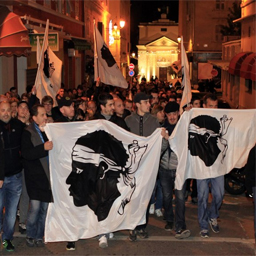
Nationalism The short answer to the question, is there a nationalist movement in Corsica? is Yes. However the short answer might tend to mislead. There are nationalists as well as those in favour of autonomy rather than independence. There are extremists at either end - separatists to republicans. There are clandestine groups and there are mainstream political parties. There are nationalists per se as well as those who are nationalistic. Two thirds of people in Corsica express themselves far from the nationalists, but the issues transcend such reductionism. In a recent survey only 13 per cent expressed themselves as favourable towards independence.
There are those who would trace modern nationalism to the event in 1975 when Dr Edmond Simeoni and others occupied the wine cellars of a pied noir (repatriated French from Algeria, after independence) - that ended with the death of two gendarmes. The then prime minister Jacques Chirac and his interior minister reacted over zealously to what was a strong grievance of local people. The story thereafter is better treated elsewhere, but it's a story that cannot be said to be resolved nearly 30 years later.
The nature of government and fiscal powers, as part of France or not, are key questions. There is a strong desire for greater recognition of the Corsican people - their identity, culture and language . Another prime issue is what constitutes appropriate economic development in agriculture, industry, transport and tourism, for example.
The debate/struggle has been going on for a long time; some would say since ever, but earnest discussion about the future of Corsica continues to take place between Corsican elected representatives and the French Government. Twenty per cent of political prisoners in mainland France are Corsican. This is still a contentious matter, since many people in Corsica, no matter what their political views would like to see more of these detainees imprisoned in Corsica, thus reducing the hardship of families in visiting. The case of Jean Castela is a specially poignant case: he has been in preventative detention without trial for over six years in Paris and has had not the best treatment for two heart attacks.
A considerable number of competences have been transferred to the Corsican Regional Council (CTC) (in the areas of: planning, economic development, education & training, sport & tourism, environmental protection, infrastructure & local services and transport). New fiscal arrangements are in hand with regard to investment credits, indirect taxation, inheritance tax, the new loan guarantee scheme and the establishment of a local leasing company.
The Corsican Connection The links between the politics of France and Corsica are obviously interwoven; in addition there has been since the 1930s frequent interlinkage between the powers of politicians, state officials and criminals. Detailled evidence is presented in a book by two senior Paris journalists, Jacques Follorou and Vincent Nouzille - Les Parrains Corses (Corsican Godfathers). It is very revealing not only about criminality, but also about the intractability of the Corsican political problem (as seen from Paris) or the Corsican grievance (as seen by Corsicans). The book does no one any favours and most particularly not to successive French Governments and their officials. I recommend it to French speakers in that it gives a very different perspective on the 'Corsican question'. It also shows the networking nature of Corsica - since the war there seem to have been no 'capos' in the Scicillian manner.
Change since the Raffarin Government
The change in government has brought a new uncertainty to the situation, but there continue to be positive signs under the Jean-Pierre Raffarin Administration and now that of Dominique de Villepin."I am not ensconced in Parisian logic," Raffarin said during an early visit to Corsica and seems to want to continue the dialogue, adding "we want to be reactive, creative and active", though I don't think de Villepin would go quite so far!
The Corsican executive is responsible for education, cultural affairs, environment, maritime affairs, agriculture, young people and sports. It is good that despite the efforts of Jacobin hard-liners, there is a growing concensus for giving regions, and especially Corsica, more freedom and responsibility as far as decision-making on matters of local concern.
The Raffarin Government's held a referendum in Corsica among its 180 000 electors in July 2003 to respond to vote on the new government's proposal to make structural changes. One of the proposals seemed very Jacobin to me: the single legislative and tax-levying assembly for Corsica would have seen the ending of the two départements, but not the ending of the two préfectures - the local embodiments of the central (Paris) state. The vote was a close run thing - 50.97% no and 49.03% yes. So the Government has had to go back to the drawing board. Nicholas Sarcozy, the ex-interior minister (now finance) said that he would not leave Corsica stranded and in any event decentralisation is in theory present public policy.

If you would like to see back issues of the newsletter, click here.
Other pages: Home Page | FAQs | Corsican Websites | Corsican Music | Travel to Corsica | Corsica's Climate & Weather | Corsican Tastes & Scents | Symbols of Corsica | Corsican Language | Corsica's Mountains and Coast | Business in Corsica | British & American Connections with Corsica | Newsletters | Contact
This page: Corsica Today | The Economy | Public Institutions | Politics | Media | Historical Personages | Education
The 2004 Corsican regional elections delivered an interesting result. While the rest of France's regions have all been taken by the socialists and their friends (except Alsace), shocking the President and the right, the position in Corsica is that while the single biggest group (25.05%) is the UMP (Gaullist), the combined socialist block has 49.8%. The balance is held by the united nationalists Unione Naziunale (17.3%).
The French regional elections are conducted under a list-based proportional representation system and for the first time, this election has been under a gender parity system. The turnout was higher here than elsewhere in France at 75% where it was about 65%.
Veteran nationalist Dr Edmond Simeoni, of the National Union (Unione Naziunale) shares its leadership with Jean-Guy Talamoni of Corsica Nazione. Jointly they cemented the coming together of nine different nationalist/autonomist parties though they have not merged, but formed a common programme for this election and the longer term. It is based on the ending of clandestine violence and on the economic, social and institutional aspects of the country's politics. Last time Corsica Nazione was on its own and had 16.76%.
The public posts of the executive are: José Rossi - economic development; Antoine Sinaldi - transport; Stéphanie Grimaldi - water; Jérôme Polverini - environment, planning & housing; Antoine Giorgi - tourism, education & training; Jean-Claude Bonacorsi - agriculture; Sauveur Gandolfi-Scheit - sport, health & social affairs; Simone Guerrini - youth heritage & culture. Ange Santini, the new president of the executive has stood down as mayor of Calvi, following the legislation that disallows the holder of more than one executive office. He also heads finance and administration.
Other pages: Home Page | FAQs | Corsican Websites | Corsican Music | Travel to Corsica | Corsica's Climate & Weather | Corsican Tastes & Scents | Symbols of Corsica | Corsican Language | Corsica's Mountains and Coast | Business in Corsica | British & American Connections with Corsica | Newsletters | Contact
This page: Corsica Today | The Economy | Public Institutions | Politics | Media | Historical Personages | Education
The Corsican economy had a GDP in 2000 of €4 593 million. This had risen to €4 777 million in 2001. In this progression it follows the pattern of the French economy as a whole (but it runs at about 20% of the national average per capita) with the notable exception that activity is concentrated in the lower value-added sectors of public (31% of the work force!) and private services. Pay is lower and there are fewer working women in Corsica by comparison with the rest of France. Also Corsica has the lowest concentration in France of technical diploma holders as a percentage of the working population.
Employment in the private sector is rising as a percentage of the whole and that is rising too. There are 97 400 jobs in Corsica (end 2004) a thirteen per cent rise in five years.
Of the 64 489 people working in the tertiary sectors in January 1999, 24.2% worked in public administration; 22.3% worked in education and health; 10.2% worked in retail; 7.5% worked in hotels and restaurants and 6.3% worked in transport. Of course these figures struck at the lowest ebb of the tourist season are much different in July and August. It is an economy where there is a very high level of seasonal employment. Actual employment numbers in the main sectors include 23 000 in the public sector, 30 000 directly or indirectly in tourism, and 8 000 in the building trades.
Industry accounts for very small numbers and among the ten largest industrial employers in Corsica, three are bakeries. Economic life in Corsica is heavily dependent upon its connections with the outside world - and their reliability, regularity, ease and cost.
The number of active members of the population was 85 700 (out of a total of 272 000) in 1999 and is the lowest rate in France, especially among women. Unemployment runs at about the national average, having coming down 30% in five years (end of 2004: 10.8% in Corsica, 10% nationally). Private sector job creation has progressed 10% between 1997-2002, reversing a 20 year trend.
The size of industrial establishments by number of employees is very small. Of 1524 establishments, 671 had no employees at all and only 11 had more than 50 in the year 2000. There were 2200 enterprises created in 2000 and the number of failures was reduced to 240 from 360 the year before, but don't imagine that these are the kind of businesses that would be recognised in the industrial heartlands of Europe. Most will have employed only one person.
Incomes are much lower in Corsica than in mainland France and it is only the large number of retired people and state employees that the level is only lower by 2% than the average for the provincial regions of France. Salary levels of people in the private sector average only £6800 pa and a quarter of workers earn less than £5000 pa.
Corsica has an ageing population and it is forecast that over 30% will be in the 60+ category by 2030. It should not be forgotten that the total population is only 260 000, though in August this rises temporarily to about three-quarters of a million. The rhythm of economic life follows this pattern and unemployment, for example, runs at about 9 000 people in the summer, rising to 15 000 in the winter. Two-thirds of the population live in the coastal areas and this is forecast to rise to three-quarters by 2030. It is hardly surprising, therefore that the Region has put in place many policies and incentives to encourage people to resettle or stay in the the interior.
Equally there is great emphasis placed on quality in agricultural production and for example, only 12% of the island's wine production is vin de table. The rest is either AOC (80%) or Vin de Pays (8%). The sheep population is rising both in number and quality, as is the resulting cheese production. Big changes are taking place against a difficult conjuncture: small units and an ageing farming population. Against this some of the essential quality of Corsican production is based on small scale artisanal production. In olive oil, output has been rising strongly, since the product is so good, but the average age of producers is more than 60 and many others are additional rather than main activities. I know oil producer who is a council worker, another is a solar heating supplier. Big opportunities exist for the highly depopulated mountain areas, especially in tourism linked agriculture, but the life is hard.
In enterprise creation Corsica is ahead of the French national average in every sector except industry and services to industry. The rate of enterprise creation in Corsica is running at 14.3% (2004) by comparison with the national rate of 9%. It is the second most dynamic region in this sense, after the Limousin. Likewise the rate of enterprise failures is lower than the national rate - 1.3% vs 1.7%. In 2004 the most dynamic sectors were building and civil engineering, the new technologies, services and the agri business.
While the tourist industry has an obvious importance for the economy, the dangers of such a concentration have already been appreciated and great emphasis is placed upon rural and agricultural development. This complements and supports the tourist trade as well as being destined to present further desertification of the interior. The country's rich cultural heritage is also been bolstered, not least because it has not suffered the same degradation as in more industrialised parts of Europe.
The agri-food business (€230 million) is in second place of importance behind tourism. The sector includes both farm and industrial production. For the most part sales are within Corsica (71%) with a quarter in continental France and only 5% is export, but this latter part is fast growing. The biggest export buyers are Italy, the USA,Germany and Switzerland. The main products are wine, charcuterie, cheese, olive oil, chestnut flour, honey, biscuits and farmed fish.
Corsica has one of the least polluted environments of the Mediterranean, but is under heavy pressure, not least from the island's biggest industry - tourism. There are people working on ensuring that the number of tourists doubles in the next 30 years to 4 million. The Balearic islands receive 13 times as many tourist per resident/capita as Corsica at present. Corsica's 2 million visitors compare with their 10.8 million. It is not surprising that the biggest problem cited by people there is urbanisation. In such circumstances withstanding the environmental pressure in Corsica will be difficult (in the Balearics, the Government has put a total stop on development until 2003!). However, there are many forces at work to encourage sustainable development. Currently about 30% of electricity production is hydraulic (3 stations) and wind energy (2 stations) is being rapidly developed. Following Ireland's lead, the use of plastic bags has been banned in supermarkets.
Growth in numbers of tourists is subject to great variation, by location, country of origin and other factors. Air passenger growth was 3% in 2000 over 1999 in both Ajaccio (4 out of 6 air travellers to Corsica) and Bastia, but was up 15% in Calvi (with the highest volume of international arrivals). Figari's numbers dropped slightly in the same period. In 2000, of foreign visitors (about a third of all holiday makers staying in hotels), the most hotel nights were were spent by Italians, followed by Germans and British (with Swedes not far behind). Whereas half of all visitors who camped were foreigners, two thirds of whom were Italian or German, followed by the Swiss and the Dutch. Hotels and campsites have the highest occupancy rates in the Balagne and the far south and the Balagne does particularly well with hotels guests in June.
In 2001 there was a growth of 4.8% in passenger traffic between May and September and almost all of that growth came from additional numbers of visitors in May, June and September - good news for Corsica, which has long been pretty saturated in July and August. In those three months, the weather is wonderful - as a rule. The hotel trade has been a big gainer with occupancy rates attaining 60% in April, 70% in May, 77% in June, 75% in July, 90% in August and 80% in September.
Employment levels fluctuate seasonally, given the importance of tourism. However employment in Corsica in agriculture, construction and the tertiary sectors is growing faster than in France as a whole. It is only in industry that it's growing slower - as you'd expect.
The two biggest concentrations (1999 figures) of tourists in Corsica are in the Porto Vecchio (66 000 beds) and Calvi (59 000 beds) regions, outside the Bastia region (86 000 beds) which is geographically much larger and takes in Cap Corse. Calvi airport sees the biggest numbers of foreign tourists (54 thousand) of any Corsican airport, while the greatest volume passes through Ajaccio (just over 1 million).
Though Corsica has a relatively small number of tourists by comparison with say the Balearics, tourist 'pressure' (the proportion of tourists to population) is relatively high (6.8), coming second to the Balearics (11.2) and way ahead of neighbouring Sardinia (0.8) among the Mediterranean islands. This results from several factors, not least the very low population density - 20% of the density of the Balearics and the lowest of any of the main Mediterranean island groups.
Other pages: Home Page | FAQs | Corsican Websites | Corsican Music | Travel to Corsica | Corsica's Climate & Weather | Corsican Tastes & Scents | Symbols of Corsica | Corsican Language | Corsica's Mountains and Coast | Business in Corsica | British & American Connections with Corsica | Newsletters | Contact
This page: Corsica Today | The Economy | Public Institutions | Politics | Media | Historical Personages | Education

Corsican Regional Prefecture (corse.pref.gouv.fr) - this is an informative site to guide your enquiries about the role and actions of central government within the region of Corsica. It is also a convenient place from which to download French Government forms for all kinds of different purposes. For anyone wanting to set up in business here, it's essential reading.
Corsican Regional Government (http://www.corse.fr/) - The Collectivité Territoriale Corse (CTC) is the island's government. This is a pretty comprehensive site and an important port of call for anyone wanting to deal with any aspect of Corsican bureaucracy. For any student of Corsica, I would say it's worth a visit. If you want to do business in Corsica, it's a must.
Economic and Social Council (www.ifrance.com/cesc) is the official consultative body for regional government - The Collectivité Territorial. The site is helpful (and put together by the secretary general, Jean-Baptiste Caporossi) to understanding many aspects of Corsican life and provides links for further exploration. The president of the Cesc is Raymond Ceccaldi. This is an excellent site, where you can find out much of what goes on at the political level in Corsica, including the daily agenda of the Assemblée de Corse.
Corsican Statistics (www.insee.fr/fr/insee_regions/corse) - an essential site for any intending entrepreneur; it has all the basic statistics for Corsica and the key local publications of the French national statistics institute. They publish the review Economie Corse and issue No 94 came out in January 2001.
Département of Haute Corse (www.cg2b.fr) - The Conseil Général of 2B (the département's official number) is the local government for the northern part of the island. An informative site, with coming events for three months ahead. It is regularly updated.
Département of Corse du Sud (www.cg-corsedusud.fr/index.php?) - The Conseil Général of 2A, as with the above, this is a site full of useful information concerning Corse du Sud.
The Regional Natural Park (www.parc-naturel-corse.com) - a guide to the Parc Naturel Régional de la Corse, which covers a third of the island's surface. Unless you have a 100% beach holiday, you are very likely to visit some part of the park.
Environment (www.oec.fr/) - the Observatory of the Environment of Corsica, in which you can find a great deal of information on the natural and built environment as well as official texts, links to many other sites.
Corsican Water (www.touspourleau.fr/corse/accueil.php) - the site of the Comité de bassin de Corse; it groups the regional and local government, economic interests, the voluntary sector and the state.
Civil Service College (www.fonction-publique.gouv.fr/irabastia) - the site of one of France's five l'Institut Régionaux d'Administration, based in Bastia.
Corsican notaries (www.notaires.fr/csn/textes.nsf/Frame+GB/index?OpenDocument)
- this link takes you to the English language
version of the national notaries site (or go to the regional site for
Corsica - www.cr-corse.notaires.fr,
where there is an annuaire as well, but the site is only in French),
but the you can find links to the list of 17 public notaries in Haute
Corse and the 10 in Corse du Sud in the
directory.
The Court of Appeal of Bastia
(www.ca-bastia.justice.fr) - here's
guidance on which part of the justice system does what, where to find
barristers, their fees and all sort of other relevant legal information.
Mayors' Association of Haute Corse (www.amahco.com) - an excellent (dry) site, where you can find all the references you need to contact any town or village and there's a very useful section for any official form that you may need from a Mairie with downloads.
Other pages: Home Page | FAQs | Corsican Websites | Corsican Music | Travel to Corsica | Corsica's Climate & Weather | Corsican Tastes & Scents | Symbols of Corsica | Corsican Language | Corsica's Mountains and Coast | Business in Corsica | British & American Connections with Corsica | Newsletters | Contact
This page: Corsica Today | The Economy | Public Institutions | Politics | Media | Historical Personages | Education
Corsica
Nazione (www.corsica-nazione.com)
- one of
the significant nationalist parties and the only one currently
represented in the Corsican Assembly. A very good site, by the way.
Paul Giacobbi (www.paul-giacobbi.org) - Mr Giacobbi is the President of the Conseil Général of Haute Corse and the national deputy for Corte/Calvi; he's also a member of the groupe d'amitié France-Grande Bretagne et Irelande du Nord in Parliament. The site is all you'd expect of a parliamentarian.
Battifocu (www.battifocu.com) - this is the site of a Corsican resistance magazine. If you want to gain some understanding of the fiercely determined nationalists, this is a place to go.
Esprit Democrate (www.espritdemocrate.com) - a nascent Corsican Think Tank, as yet to be much listened to or talked about.
Corsican socialists (perso.wanadoo.fr/manca-naziunale) - the site of A Manca Naziunale, Corsican socialists.
Parti Radical Gauche (prg-2b.org) - the Corsican chapter of the PRG.
Europe in Corsica (www.corsica.to/maison-europe) - this is the site of Corsica's Maison de l'Europe.
European Rural Crossroads (www.europe-corse.org) - this is the weekly bulletin which informs on all kinds of potential partnerships and the activities of the EU institutions. You'll also find a catalogue of the EU publications and links to EU institution sites.
Corse Nouvelle (corsenouvelle.free.fr) - this is the party of regional councillor Philippe Ceccaldi, the founder of Corsica's airline, Compagnie Corse Méditerranée, now rebaptised CCM Airlines. He's a social democrat, I'd say.
Unita Naziunale (www.unita-naziunale.org/)
- the
committee of the Fiumorbu linked many nationalist organisations and
this is their site.
Isula.net (www.isula.net) - a site born from the secondary schools of Bastia. The association aims at reflecting on current issues and creating cultural productions; running a 'philosophy café' and workshops to preserve and enhance the environment. You can listen to some songs on the site.
Rousseau's constitution (www.constitution.org/jjr/corsica.htm) - Jean-Jacques Rousseau, though he never came to Corsica, wrote a constitutional project for Corsica in 1765. It still makes interesting reading today.
Paoli's constitution (le-village.ifrance.com/resistanza/laconstitutiondepaoli.htm)
- here is the 1755 constitution of Pasquale
Paoli, translated into French. Many say this had a
big
influence on the US constitution... 
Independza Corsa (www.infinito.it/utenti/freekyrn)
- a site in Corsican of a new organisation,
issue of the University
at Corte, which has a mailing list you can join and links to
many other independence movements.
Geopolitical Corsica (www.multimania.com/geopoliticorse/) - this is a good site and relatively new. It archives articles and is a bibliography of writing on the subject as well as offering a debating opportunity.
Resistenza (wanadoo.fr/resistanza) - a good political-social-historical site seen from an independentist viewpoint, with a strong cultural overlay.
Eurisles (www.eurisles.com)
- this is the islands commission of the
Conference of Peripheral Maritime Regions of Europe (www.crpm.org). The
organisation undertakes studies and organises meetings to promote the
special needs and interests of its members.
IMEDOC (www.bitel.es/dir~cbe/ime.htm) - this is the co-operative organisation of the Western Mediterranean islands of Corsica, Sardinia and the Balearics.
History of the FLNC (furiani.free.fr/flnc/flnc02.htm) - this page of a wider site gives a short history of the Front National pour la Libération de la Corse.
L'Accolta Naziunale Corsa (www.anc-corsica.com) - the site of the ANC - a party for Corsica's autodetermination.
International Centre for Island Studies (www.islandstudies.org) - the name of this organisation is self-explanatory
Other pages: Home Page | FAQs | Corsican Websites | Corsican Music | Travel to Corsica | Corsica's Climate & Weather | Corsican Tastes & Scents | Symbols of Corsica | Corsican Language | Corsica's Mountains and Coast | Business in Corsica | British & American Connections with Corsica | Newsletters | Contact
This page: Corsica Today | The Economy | Public Institutions | Politics | Media | Historical Personages | Education
The latest news on the satellite channel is that the CTC has approved a (lowered) budget, but it looks as though the project may finally see the light of day after 4 years of trials and tribulations. keep signing the petition though!
Corsica (www.corsica-info.com)
- when the two Corsican daily newspapers merged,
this excellent monthly magazine called 'Corsica' (in French, with a few
articles in Corsican) was started. The electronic version is well
presented and easy to use; it has a short 'what's on' and news sections
- useful for visitors.
Voce Nustrale (voce.fr.fm) - the site of the voluntary radio station of ADECEC, the cultural association based in Cervione. Here you can hear programmes live, 5 days a week.
A Vista Prima (www.avistaprima.com) - a news site that also has texts on politics, culture, sport and other subjects, as well as the words of 250 Corsican songs and a classified advertising section (vacation properties to pets).
FR3 Corse (www.corse.france3.fr/)
- this regional television station continuously
grows in strength. The site is excellent and for any French speaker an
excellent way of both keeping up with news and following social and
cultural developments. Programme clips and full programme are available
on line in both French and Corsican.
Stantari (www.stantari.net) - a new magazine devoted to Corsican natural history and culture. Well worth picking up a paper copy if you see one in the magazine rack. The website's good too.
Corse Matin (www.corsematin.com) - if you want to know what's going on in the micro-regions of the island, here's a way to find out. The island's daily - printed in Nice and soon to be printed in Bastia. Corse Matin is building a brand new printing plant at Poretta (Bastia) Airport to produce the paper on the island.
Corsicamag (www.corsicamag.com) - this is an audacious venture, it's a monthly online magazine. It has editorial, info, small ads and links not only to Corsican, but other sites in France.
Journal de la Corse (www.jdcorse.com/)
- this is a weekly newspaper that offers much
the same electronically as it does on paper. You can look up back
issues, as well. You will need to speak French and (in part) Corsican
to understand. Claims to be France's oldest newspaper - it started in
1817.
Yahoo's Corsican news (fr.fc.yahoo.com/c/corse.html)
- here's a surprisingly useful news source on Corsica .
Radio Calvi
Citadelle
(www.radiocalvi.com) - a new site and
a good one, still under development. Will Keyser used to be the station's
vice-president and considers it's among the
best of the volunteer stations in the business. It is on 91.7 FM - if
you visit Calvi, listen - there's a lot of Corsican as well as other
music + local & regional news and culture. And you can listen
to it anywhere in the world! The station had its 201st birthday in 2004. It has very good streaming, so you can listen to it wherever you are. If you like Corsican music, there are two slots a day.
Radio Corti Vivu
(members.aol.com/RCV926)
- just to show I'm not partial: this is another
good volunteer local radio station - in Corte. They are in a building
opposite the national palace (a simple sort of place, but dignified and
home to occasional exhibition and the center for Corsican studies). 
Alta Frequenza (www.alta-frequenza.com) - a regional station started in 1981, on which site you can listen to the morning and evening news bulletins.
RCFM (www.bleurcfm.com) - Radio Bleu is the national chain of local radio stations. RCFM is the Corsican station, where among other things you can listen to the news in French and Corsican.
Corse Infos (www.corseinfos.org) - Rose Paolacci puts video clips on this news site daily. She is the Corsica correspondent for the satellite channel i-télévision and a stringer for TF1. Also a very good place to see a summary of the present French Government proposals and the process of getting there.
Amateur Radio (tk5ep.free.fr) - a delightfully personal site of an Ajaccio radio amateur. Nice photos and a bit about Corsica. Patrick Egloff, a continental married to a Corsican.
Corsica Net Info (corsica-info.ifrance.com/corsica-info) - is a source of news and other information about Corsica, including the latest sports results.
Ribellu (www.webzinemaker.com/ribellu) - a new Corsican nationalist webzine.
Echo de Balagne (www.echo-de-balagne.com) - this is a small mag that covers the Balagne microregion. Its new web site enables you to see and place small ads of all sorts.
For a list of magazines published in Corsica, click here. You can also visit national newspaper sites like Le Monde (www.tout.lemonde.fr) or Libération (www.liberation.fr/corse), both of which have regular coverage of Corsica - Le Monde to the right and Libé to the left. An online source is Yahoo (fr.news.yahoo.com/pg/francepolitique/). If you'd like to be kept informed on Corsican political news, then subscribe to pulitica@ml.free.fr. You'll get a Corsican press review by daily email.
Other pages: Home Page | FAQs | Corsican Websites | Corsican Music | Travel to Corsica | Corsica's Climate & Weather | Corsican Tastes & Scents | Symbols of Corsica | Corsican Language | Corsica's Mountains and Coast | Business in Corsica | British & American Connections with Corsica | Newsletters | Contact
This page: Corsica Today | The Economy | Public Institutions | Politics | Media | Historical Personages | Education
Boney is the person that people often connect with Corsica, but he was no local patriot, though his image is being resuscitated, especially in Ajaccio, his birthplace. Corsica's history is long and complex. There are lots of neolithic remains - dolmens, standing stones. The Greeks were here and the Romans, too - there are fine Roman sites to visit. It formed part of the Byzantine Empire. It has seen Saracens and Popes, though its 'modern' history started in the C11th with the Pisan domination (1077-1284). The Genoese kept a tenuous hold from 1284-1768, not without rebellions (notably of Sampiero Corsu in the C16th), Aragonese and French interventions. By the mid C18th the Genoese were confined to their coastal citadels. That was the century of much fighting and some independence. Pasquale Paoli was the most significant patriot, though he spent about half his life in London exile. It was he who sought British help that resulted in the arrival of Nelson and a two-year Anglo-Corsican kingdom (1794-96). The French have been there since. This brief summary does no justice to the Corsican story, but might intrigue you to look a bit deeper. The next step might be to go to a Corsican history site and travel on from there.
Seneca
(library.thinkquest.org/11402/bio_seneca.html)
- Lucius Annaeus Seneca, born in Spain,
philosopher, politician, and tutor to the young Nero. When Nero became
emperor, Seneca became one of his chief advisers, condoned his crimes
and became rich. He spent eight years (A.D. 41-9) in Corsica, exiled by
the Emperor Claudius, because the empress Messallina had accused him of
adultery with Julia Livilla, Caligula's sister. Back home, he was
accused of participating in the conspiracy of Piso and was ordered to
take his own life, which he did with stoic courage. The Tower of Seneca
is where legend has it that he lived. It stands to the west of Luri in
Cap Corse. He would more likely have been at either of the Roman
colonies at Mariana or Aleria on the east coast.
Napoleon, of
course
(www.napoleon1er.com)
and Russian-
an elaborate site about the man, whom most anglo-saxons immediately
associate with Corsica, but remarkably few Corsicans regard as a hero.
Links to 24 other Napoleonic sites (the picture above shows him at 33).
Napoleon, with a lighter touch (www.napoleon.org)
- this is the site of the Fondation
Napoleon and is much less reverential. It's fun, especially
for someone from perfidious Albion.
Napoleon archives (www.napoleonica.org) - this is a site that will grow as more letters and archives, such as the Council of State papers are added. You can already find 245 portraits by Frédérick Christophe Houdetot on it.
Napoleon seen by perfidious Albion (www.n-a.co.uk)
- n-a does not stand for 'not applicable', but
for the Napoleonic Association: the British perspective on their béte
noir. Go from here to re-enactments.
The Napoleon Institute (www.institut-napoleon.org) - this is the serious academic stuff, learned articles and such.
L'tit Caporal seen by a 16-year old (perso.respublica.fr/empire) - but don't be fooled. This is an excellent site and very well conceived. A pleasure to visit.
Napoleon Bonaparte Internet Guide
(napoleonbonaparte.nl)
- a labour of love by Paul Hilferink, a Dutchman who guides you to
other Napoleonic sites with a light touch.
Bonaparte & Paoli - Charles Napoleon is the princely descendent of Boney's brother Jérôme and he has written a book called Bonaparte et Paoli aux origines de la question corse. Charles has forsaken Paris and returned to his origins in Ajaccio where he is an adjoint to the Maire of Ajaccio.
Pasquale Paoli
(www.sitec.fr/storiacorsa)
- he is Corsica's real hero, the eighteenth
century revolutionary leader, whose written constitution had a strong
influence on the US one of such renown. Apart from inspiring his
compatriots (and still does today!), he spent two long periods of exile
in London and was initially buried in Westminster Abbey, where you can
still see his memorial plaque. He was befriended by James Boswell, who
made a pilgrimage to meet him and then, as he did, wrote An
Account of Corsica, much of it about Paoli. There
is a new biography of Paoli by Antoine-Marie Graziani, as well as the
first volume (ultimately be 10 vols) of his letters, due out in 2002. 
Pasquale Paoli 2
(www.pasqualepaoli.com)
- a new site which is excellent and will grow as it receives further
attention from Marc Alfonsi its creator. He is the organiser of the
Corsican Webring, of which Corsica Isula is a member.
Pasquale Paoli 3 (www.pascalpaoli.org) - this is an excellent and informative site by Anton'Maria Battesti, a Paris law student. It has the full Paoli constitution and some excellent illustrations, including the commemorative plaque in London's Westminster Abbey.
Sampieru Corsu
(perso.wanadoo.fr/resistenza)
- an earlier swashbuckling hero of Corsica
(1448-1567). Secretly aided by Catherine di Medici, he raised a
rebellion against Genoa in 1564. He assassinated his wife and he
himself was assassinated. On this site is the text and music of the
national anthem. (Note: the resistanza site is in course of
reconstruction).
Luiggi Giaferri (perso.wanadoo.fr/resistenza)
- the early nationalist 1668-1748. In 1731
national independence was declared and a constitution adopted. Giaferri
was a contemporary of Pasquale Paoli's father Giacinto, with whom he
was elected a Primate of the Nation. (Note: the resistanza site is in
course of reconstruction).
Christopher Columbus's family tree (www.citeweb.net/tk5yp/colomb/photocc.htm) - as everyone knows Columbus was actually born in Calvi, Corsica in about 1436. It was just that the Genoese, master of the town at the time, expatriated the records.
Listing of Celebrated Corsicans (furiani.free.fr/corses.htm) - this is a simple listing and very helpful, nonetheless.
Other pages: Home Page | FAQs | Corsican Websites | Corsican Music | Travel to Corsica | Corsica's Climate & Weather | Corsican Tastes & Scents | Symbols of Corsica | Corsican Language | Corsica's Mountains and Coast | Business in Corsica | British & American Connections with Corsica | Newsletters | Contact
This page: Corsica Today | The Economy | Public Institutions | Politics | Media | Historical Personages | Education
University of Corsica (www.univ-corse.fr) - this site can lead you on to others in your specific line of interest (faculties and the outreach programme). The university is named after Pasquale Paoli, was founded by the latter in the C18 and re-opened in 1981. This year it has 4000 students. It is located in Corte, the island's ancient capital. The immediate past president, Jacques-Henri Balbi led the institution to occupy a significant place in the environmental world - the first Environment and Mediterranean Identity international conference was held in 2000. The new president Antoine Aiello is continuing the path.
The University has established an Insitut de l'Environnement and it currently has a teaching/research staff of 140. It has four research centres: physical systems of the environment; island and Mediterranean biodiversity; islands & sustainable development and institutions of the Mediterranean; Corsica-Mediterranean, which includes a data bank on the Corsican language. The director is Jacques Orsoni.
Two 'environmental schools' are to be built at Lupino by the city of Bastia. Hmm! A nursery school and a primary are to be established with a curriculum that focuses on science and especially on renewable energy. They will have solar energy, wind power, recycling of waste water and so on, with four labs to demonstrate good environmental practice.
The University Library (scd.univ-corse.fr) - this is the documentation service and the site has an excellent catalogue. It's open to be consulted by anyone online, but you need to be a student or official reader to access the books and other resources.
Academy of Corsica (www.ac-corse.fr) - Corsica's 'ministry of education' with curricula, lists of schools etc - plus a Corsican language section.
L'Associu per l'Università (www.associu.com) - the University association is a place of debate for issues of importance to Corsica in the fields especially dear to the university, such as the environment, the internationalisation of the university, water and others.
U Marinu (www.umarinu.com) - a pedagogic association to educate and inform kids and no so small kids on the sea environment - with lots of activities.
Jean Nicoli (www.multimania.com/centre2/nicoli.htm) - this is the site of a secondary school in Bastia with good regional, cultural and musical information. This site offers far more than you might expect.
Coggia School (www.coggia.com/EcoledeCoggia/index.html) - a delightful site of the southern Corsica infant and primary school that won the prize Net d'Or de l'Académie de Corse.
Journal Scolaire de la Corse (www.corse-presse.org) - an ambitious Ajaccio school site led by PP Battesti, with lots of articles by kids.
Other pages: Home Page | FAQs | Corsican Websites | Corsican Music | Travel to Corsica | Corsica's Climate & Weather | Corsican Tastes & Scents | Symbols of Corsica | Corsican Language | Corsica's Mountains and Coast | Business in Corsica | British & American Connections with Corsica | Newsletters | Contact
This page: Corsica Today | The Economy | Public Institutions | Politics | Media | Historical Personages | Education

write to: mac @ corsica-isula.com
Managed in association with Corsica Holiday with a little help from Will Keyser